Sales Summary & Analytics Guide
A comprehensive guide to viewing your sales history, analyzing performance, and understanding your token sales data on TradePoint.
1. Introduction
The Summary & Analytics page is your central hub for reviewing historical sales performance. It provides detailed tables, visual charts, and data export capabilities to help you understand how your automated token sales have performed over time.
What You Can Do
- View Sales History - See all executed sales with dates and amounts
- Analyze Performance - Track USDT rates and volumes over time
- Compare Periods - Switch between yearly, monthly, or custom date ranges
- Visualize Trends - View charts showing volume and rate patterns
- Export Data - Download CSV files for external analysis
- Track Multiple Tokens - Switch between different tokens to compare performance
[!NOTE] The Summary page shows historical data from executed sales only. It does not show pending configurations or future sales targets.
2. What is the Summary Page?
Purpose
The Summary page answers questions like:
- How much have I sold over the past month?
- What USDT rates did I get for my sales?
- What's the trend in my sales volume?
- How does this year compare to last year?
- When were my highest and lowest sales?
Data Source
The Summary page displays data from:
- ✅ Completed sales from your Sales Configurations
- ✅ Executed transactions processed by the platform
- ✅ Historical records dating back to your first sale
The page does NOT show:
- ❌ Future sales (even if configured)
- ❌ Pending sales (not yet executed)
- ❌ Sales from other users (privacy protected)
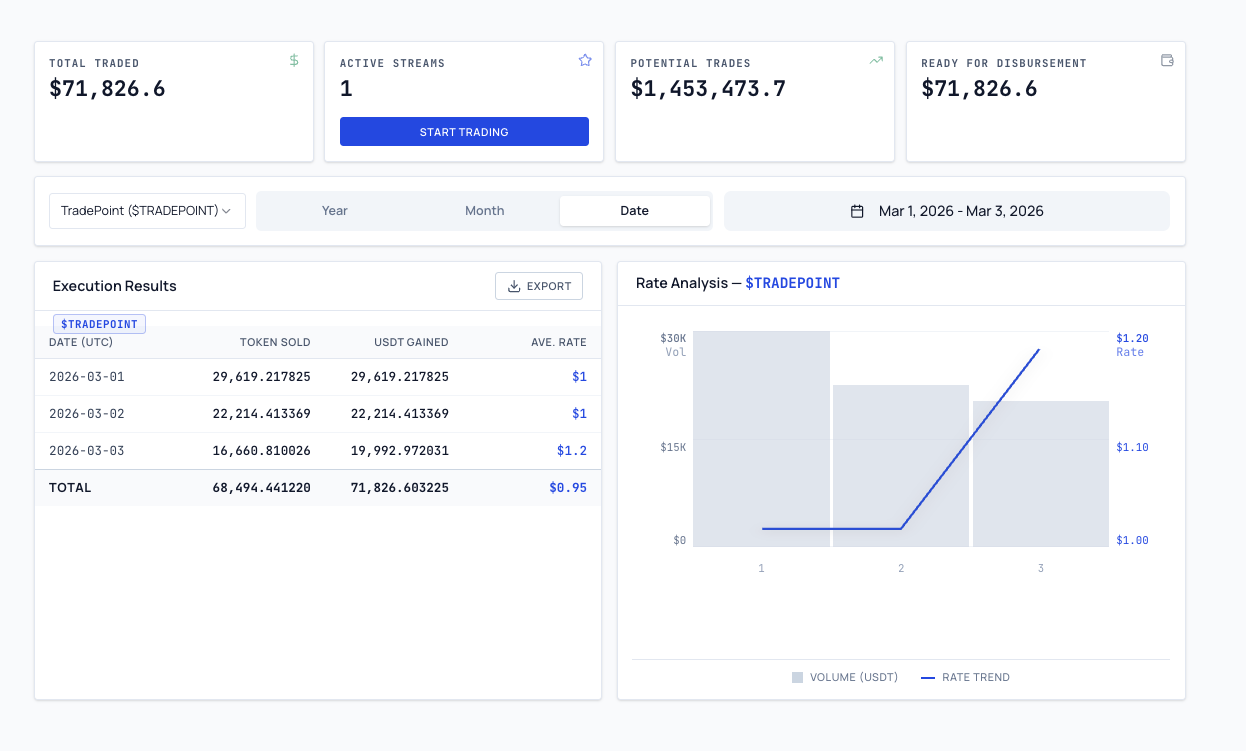
Key Components
3. Accessing the Summary Page
Step 1: Navigate to Summary
- Log into your TradePoint account
- From the main navigation menu, click "Summary"
- The Summary & Analytics page loads
Step 2: Select Your Token
When the page loads, the first available token is selected automatically. You can switch tokens using the asset dropdown in the controls panel.
What You'll See:
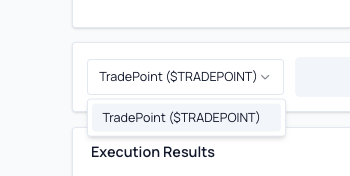
To Select a Token:
- Click the asset dropdown
- Browse available tokens (shown as "Token Name (SYMBOL)")
- Click on the token you want to view
What Happens:
- The page loads sales data for the selected token
- Both the table and chart update automatically
- Period selector shows available date ranges for this token
[!NOTE] Only tokens with sales history appear in the dropdown. If you configured sales but haven't executed any yet, the token won't show until the first sale completes.
4. Understanding the Interface
Stats Cards
At the top of the page, four summary cards provide a quick overview of your trading activity:
| Card | What It Shows |
|---|---|
| TOTAL TRADED | Total value of all tokens traded (in USD) |
| ACTIVE STREAMS | Number of currently active sales configurations |
| Potential trades | Estimated value of upcoming trades (in USD) |
| Ready for disbursement | Your current USDT balance available for payout |
The ACTIVE STREAMS card includes a "Start trading" button that takes you directly to the Sales page.
Layout Overview
Below the stats cards, the Summary page has a two-column layout (on desktop):
Left Side: Execution Results Table
- Shows detailed sales data in tabular format
- Includes token badge and Export button at the top
- Total row at the bottom
Right Side: Rate Analysis Chart
- Dual-axis visualization combining volume bars and a rate trend line
- Legend showing what each element represents
- Scrollable horizontally when more than 15 data points are shown
Both Sides Update Together:
- Selecting a period updates both table and chart
- Navigating to different months/years syncs both
- Changing tokens updates both simultaneously
5. Viewing the Execution Results Table
Table Columns
| Column | What It Shows | Example |
|---|---|---|
| Date (UTC) | Date the sale was executed | 2025-03-15 |
| Token Sold | Quantity of tokens sold | 1,000.000000 |
| USDT Gained | USDT received from the sale | 1,000 |
| Ave. Rate | Average price per token (in USD) | $1.00 |
Understanding Each Column
Date (UTC)
- Shows when the sale was executed
- Times are in Coordinated Universal Time (UTC)
- Format: YYYY-MM-DD (year-month-day)
Example:
2025-03-15 = March 15, 2025
2025-01-01 = January 1, 2025
Token Sold
- The quantity of your tokens that were sold
- Formatted using the token's configured display precision
Example:
1,000.000000 = One thousand tokens sold (6 decimal places)
USDT Gained
- The USDT you received from the sale
- This is your proceeds (what you received)
Example:
If you sold: 1,000 tokens
At rate: $1.00
USDT Gained: 1,000
Ave. Rate
- The average exchange rate for the sale
- Shown in USD currency format
- This is the price per token
Example:
$1.00 = Each token sold for $1.00
$0.99 = Each token sold for $0.99
Example Table
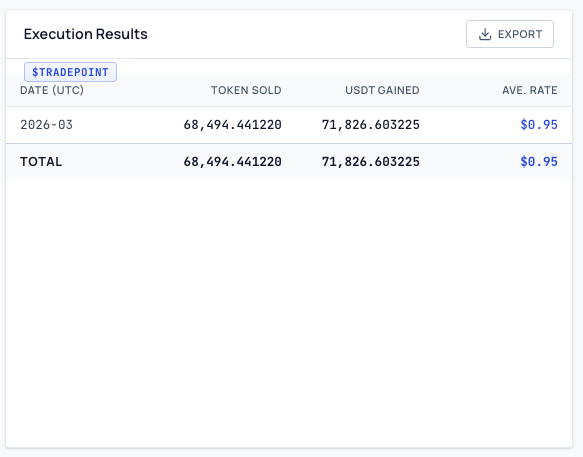
Reading This Table:
- 2025-09: Sold 300 at $1.21, received 364.2 USDT
- Total: 300 sold over 1 day, average rate $1.21
Total Row
The last row shows aggregated totals for all rows in the current view:
Total Token Sold
- Sum of all tokens sold in the period
Total USDT Gained
- Sum of all USDT received
- Value is truncated (not rounded) to match the precision of the underlying data
Average Rate
- Calculated as a weighted average: Total Token Sold ÷ Total USDT Gained
- This reflects the true average rate weighted by volume, not a simple mean of individual rates
Example Calculation:
Sales:
Day 1: 1,000 tokens → 1,000 USDT (rate: $1.00)
Day 2: 1,000 tokens → 990 USDT (rate: $0.99)
Day 3: 1,000 tokens → 1,010 USDT (rate: $1.01)

Totals:
Token Sold: 3,000
USDT Gained: 3,000
Average Rate: 3,000 ÷ 3,000 = $1.00
6. Understanding the Rate Analysis Chart
Chart Purpose
The Rate Analysis Chart visualizes both your sales volume and USDT rates over time simultaneously, making it easy to spot trends, patterns, and correlations between volume and price.
Chart Components
Left Y-Axis (Volume)
- Displays USDT volume values (in thousands, e.g., "$30K")
- Labeled "Vol"
- Corresponds to the gray bars
Right Y-Axis (Rate)
- Displays the USDT rate in USD currency format (shown in blue)
- Labeled "Rate"
- Corresponds to the blue rate trend line
Gray Bars
- Each bar represents the USDT volume (amount gained) for one period
- Taller bar = higher volume for that period
Blue Rate Trend Line
- Connects the average rate values across all periods
- Makes it easy to see rate movement over time
X-Axis Labels
- Year view: abbreviated month names (e.g., "Jan", "Feb")
- Month/Date view: day numbers
Horizontal Scrolling
- When more than 15 data points exist, the chart becomes horizontally scrollable
- A message appears: "[N] data points — scroll to view"
Tooltip on Hover
- Hover over any bar column to see a tooltip showing:
- Period label
- Volume (in USDT)
- Rate (in USD)
Legend
- Gray square = Volume (USDT)
- Blue line = Rate Trend
Reading the Chart
Visual Example:
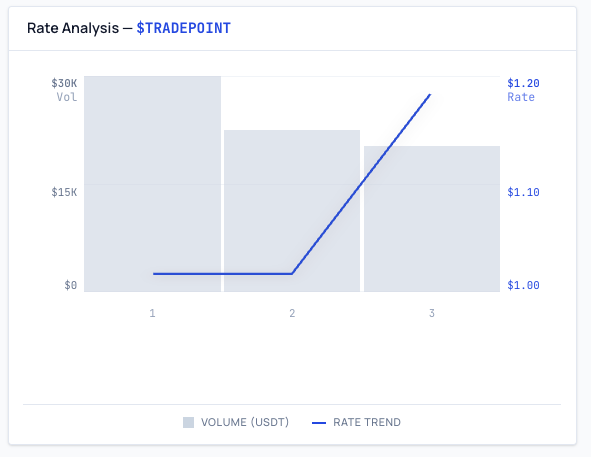
Interpretation:
- Period 1: Highest volume (~$30K) with the lowest rate at ~$1.00
- Period 2: Volume decreased (~$18K), rate remained relatively flat at ~$1.05
- Period 3: Moderate volume (~$20K) with the highest rate at ~$1.20
7. Period Selection
The Period Selector allows you to view different time ranges of your sales data.
Period Types
Three Options:
- Year - View data aggregated by month across the selected year
- Month - View daily data for the selected month
- Date - View daily data for a custom date range (defaults to last 7 days)

[!NOTE] In Year view, each table row and chart bar represents one month (not one year). In Month and Date views, each row/bar represents one day.
Navigating Between Periods
Year and Month modes:
- Use the ← Previous and → Next arrow buttons to step through available periods one at a time
- Click the period display button (showing the current period, e.g., "2025" or "January 2026") to open a scrollable grid of all available periods — click any period in the grid to jump directly to it
- The grid also shows the full date range for which data is available
Date mode:
- The Previous/Next arrows are not shown
- Click the period display button to open a dual calendar picker — select a "From" date and a "To" date to define your custom range
- The page updates automatically as you pick your dates
8. Exporting Data to CSV
Why Export to CSV?
Common Use Cases:
- External Analysis: Import into Excel, Google Sheets, or data tools
- Record Keeping: Save historical snapshots for your records
- Tax Reporting: Provide data to accountants or tax software
- Custom Visualizations: Create your own charts and reports
- Data Backup: Keep offline copies of your sales data
How to Export
Step 1: Click Export Button
- Locate the "Export" button (with a download icon) in the Execution Results card header
- Click the button to open the date range picker

Step 2: Select Date Range
A date range picker dialog opens:
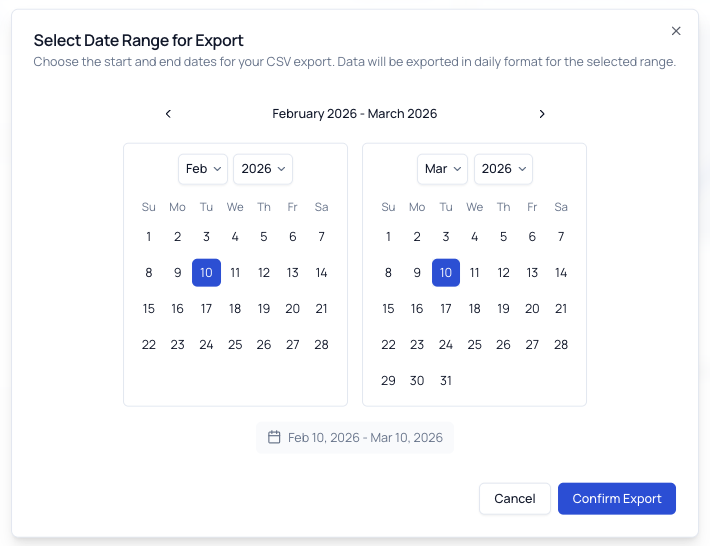
The dialog defaults to your full available history range (from your earliest sale to today).
Step 3: Confirm Export
- Select your desired date range
- Click "Export" button
- CSV file downloads automatically
File Name Format:
sales-results-BTC-2025-03-01-to-2025-03-31.csv
The file name uses the symbol of the sold token (e.g., BTC, ETH) and the selected date range.
[!NOTE] Exports always use daily aggregation regardless of the period type currently selected in the view. This ensures you always get the most granular data in your export.
CSV File Contents
Column Headers:
Date,Token Sold,USDT Gained,Ave. Rate
Example Data:
Date,Token Sold,USDT Gained,Ave. Rate
2025-03-01,1000,1000,1
2025-03-02,750,750,1
2025-03-03,1000,990,0.99
2025-03-04,1000,1010,1.01
2025-03-05,1000,1000,1
Total,4750,4750,1
What Each Column Contains:
- Date: Sale execution date (YYYY-MM-DD)
- Token Sold: Quantity of tokens sold
- USDT Gained: USDT received
- Ave. Rate: Weighted average exchange rate for that day
The last row is a Total row showing:
- Sum of all Token Sold values
- Truncated sum of USDT Gained
- Weighted average rate across all rows (Token Sold ÷ USDT Gained, truncated to data precision)
Opening the CSV File
In Excel:
- Open Excel
- Go to File > Open
- Select your downloaded CSV file
- Data appears in spreadsheet format
In Google Sheets:
- Go to Google Sheets
- Click File > Import
- Upload your CSV file
- Choose import options
- Data appears in the sheet
Tips for Analysis:
- Use SUM function to calculate totals
- Create pivot tables for deeper insights
- Generate your own custom charts
- Filter data by specific criteria
9. Frequently Asked Questions
General Questions
Q: How often is the Summary page updated? A: Data updates automatically after each daily sales execution. Sales typically appear within 1-24 hours after execution.
Q: Can I see real-time sales data? A: No. The Summary shows completed historical sales only. Real-time or pending sales are not displayed.
Q: Why don't I see any data? A: Common reasons:
- No sales have been executed yet
- Selected token has no sales history
- Selected period has no sales
- Sales configuration was recently created (wait for first execution)
Q: How far back does the data go? A: Data goes back to your first executed sale. There's no limit on historical data retention.
Q: Can I see other users' sales data? A: No. You can only see your own sales data. User data is private and protected.
Table Questions
Q: Why do some days show zero sales? A: Possible reasons:
- Sales configuration was stopped
- No available balance
- Sales processing failed for that day
- Weekend/holiday (platform-dependent)
Q: What does NULL or empty mean in the table? A: NULL typically means "no data" or "not applicable" for that field. Empty cells usually indicate zero or no sale occurred.
Q: Can I sort or filter the table? A: The table is pre-sorted by date (chronological order). Use the Period Selector to filter by time range. For advanced filtering, export to CSV and use Excel/Sheets.
Q: Why don't Token Sold and USDT Gained always match? A: They can differ because the exchange rate is not always exactly $1.00. The Ave. Rate column shows the actual rate applied.
Chart Questions
Q: What do the gray bars represent? A: The gray bars show sales volume (USDT Gained) for each period. Taller bars = more USDT received.
Q: What does the blue line represent? A: The blue line is the Rate Trend — the average USDT rate per token for each period.
Q: Why doesn't the chart show all my sales? A: The chart aggregates data based on your selected period type:
- Year view: Shows monthly aggregates
- Month view: Shows daily values
- Date view: Shows daily values within range
Q: Can I download the chart as an image? A: Not directly from the Summary page. You can take a screenshot or export data to CSV and create charts in Excel/Sheets.
Q: Why is my chart empty but the table has data? A: Try:
- Refreshing the page
- Selecting a different period
- Checking browser console for errors
- Contact support if issue persists
Export Questions
Q: What format is the exported file? A: CSV (Comma-Separated Values), which can be opened in Excel, Google Sheets, and most data tools.
Q: Does the export use daily or monthly aggregation? A: Exports always use daily aggregation, giving you the most granular data regardless of the period view currently selected.
Q: Can I export data for multiple tokens at once? A: No. Exports are per-token. To export multiple tokens, select each token and export separately.
Q: Is there a limit on export size? A: Some platforms may limit exports to 1,000 or 10,000 rows. If you need larger exports, break them into smaller date ranges or contact support.
Q: Can I schedule automatic exports? A: Not currently. Exports are manual. You can export periodically (weekly/monthly) and save the files.
Q: Where does the CSV file download to? A: Your browser's default download folder (usually "Downloads"). Check your browser's download settings to change the location.
10. Troubleshooting
Issue: Token Dropdown Shows "Loading..."
Symptoms:
- Token dropdown shows "Loading..." indefinitely
- Cannot select any token
- Page appears stuck
Solutions:
- Refresh the page:
- Press
F5orCtrl+R(Windows) /Cmd+R(Mac) - Wait 10-15 seconds for data to load
- Press
- Check internet connection:
- Ensure stable connection
- Try loading other pages
- Restart router if necessary
- Clear browser cache:
- Press
Ctrl+Shift+Delete/Cmd+Shift+Delete - Select "Cached images and files"
- Clear and reload page
- Press
- Try different browser:
- Use Chrome, Firefox, Safari, or Edge
- Disable browser extensions temporarily
- Contact support:
- If issue persists after trying above
- Provide browser information and screenshots
Issue: "No assets available" in Token Dropdown
Symptoms:
- Dropdown shows no tokens
- Message: "No assets available"
- Cannot view any data
Causes & Solutions:
Cause 1: No Sales History
- You haven't executed any sales yet
- Solution: Wait for your first sales configuration to execute. Sales data will appear after the first execution.
Cause 2: Sales Too Recent
- Sales executed but data not yet indexed
- Solution: Wait 1-24 hours after first sale for data to appear
Cause 3: System Issue
- Database or API problem
- Solution: Contact support with screenshots and details
Issue: Export Fails or Downloads Empty File
Symptoms:
- Click Export but nothing happens
- File downloads but is empty or corrupted
- Export button doesn't respond
Solutions:
- Check browser download settings:
- Ensure downloads are allowed
- Check if pop-ups are blocked
- Allow downloads from TradePoint domain
- Try different date range:
- Select smaller date range
- Large exports may time out
- Break into multiple smaller exports
- Verify data exists:
- Ensure table shows data for your range
- Cannot export empty periods
- Check file after download:
- Open CSV in text editor (Notepad, TextEdit)
- Verify it contains data
- If corrupted, try export again
- Try different browser:
- Download behavior varies by browser
- Chrome, Firefox, or Edge may work better
- Contact support:
- Provide date range attempted
- Screenshot of any errors
- Mention which browser you're using
Need More Help?
If you're still experiencing issues after trying the troubleshooting steps:
- Review related documentation:
- Trade Strategy Configuration Guide for setup questions
- Contact support with:
- Clear description of the issue
- Token symbol you're viewing
- Period type and range selected
- Steps you've already tried
- Screenshots showing the problem
- Browser name and version
- Date and time when issue occurred
When Contacting Support About Summary Page, Provide:
- Selected token
- Period type (Year/Month/Date) and specific period
- What you expected to see vs. what you actually see
- Whether table, chart, or both are affected
- Any error messages (exact wording)
- Screenshots with timestamps
This guide is maintained by the TradePoint team. Last updated: March 2026